Tuesday, April 9, 2013


White Asparagus
Spring has arrived and we have been busy planting
our crops. Last week our asparagus emerged.
Our first graders are conducting an experiement.
Our cabbage is growing well this year!
They are covering the aspargus with soil as it slowly
rises ouf of the ground. In doing so it causes the
asparagus to turn white. Many European countries enjoy
Winter Wheat is finally starting to grow
white asparagus.Other than color, there's no difference between green and white asparagus -- white asparagus is simply green asparagus that hasn't been allowed to turn green. The way white asparagus is grown is that it's covered in a thick layer of mulch and dark plastic so that no sunlight reaches the spears.This way the vegetable never gets a chance to turn green because no photosynthesis takes place. We can't wait to try it.


Spring Planting

Last week we finished our spring planting. 2nd graders planted potatoes while also harvesting spinach that has grown over the long winter. This spring we are growing a few new varieties including raspberry spinach and heirloom beets that were grown in Thomas Jefferson's gardens.
We have a few new additions to the Discovery Garden this year including blackberry bushes and a paw paw tree.
One of the great horticultural mysteries of the world is: why have most paw paw trees, that were plentiful throughout early U.S. forests, virtually disappeared from their natural habitat today? That answer may lie within the research results that showed that the paw paw is sensitive to ultraviolet light, thus, paw paw seedlings may not grow back after the forests have been harvested, and there are very few virgin forests left in the United States.

Saturday, February 23, 2013

Discovery Garden Wheat Bread

6th Grade Chemistry Unit

6th grade students recently used Discovery Garden wheat to create wheat bread baked fresh at school.
Students learned that  before yeast was manufactured commercially, women did their baking by mixing flour, salt, sugar, and potato water, and letting yeast cells in the air supply the enzymes!
The wheat bread was donated to a local homeless shelter in our area.  Our wonderul cafeteria staff helped us bake over 100 loaves.

Winter Spinach Harvest

What is that we see?! 2nd graders recently harvested spinach from the garden and munched on it for their class snack this Friday.  What a great healthy treat.
Spring Planting    After a snowstorm and snow day this week we were able to get some of our seeds in the ground today.  Kindergarten was busy planting snap peas today. 6th grade helped plant cabbage. Did you know that our cabbage plants can grow as large as basketball? We are hoping for wet and mild spring so that our seeds will grow well.


Friday, December 21, 2012


The Discovery Garden Goes High Tech

This fall with the help ouf our technology specialist Mr. Murphy, we have added QR codes to the Discovery Garden. Now parents and other community members can scan the codes that link to videos about what is growing in the garden!

5th Grade Meso America Sweet Potato Harvest


   5th graders harvested a whopper of a sweet potato crop this fall.It was the first time Terra Centre has grown sweet potatoes. The earliest cultivation records of the sweet potato date to 750 BC in Peru, although  evidence shows cultivation of the sweet potato might have begun around 2500-1850 BC.  By the time Christopher Columbus arrived in the ‘New World’ in the late 15th century, sweet potatoes were well established as food plants in South and Central America. Our sweet potato crop was used to make pies. The 5th graders, along with the help of Miss Tammy in our cafeteria, made pies and donated them to families in need this  Thanksgiving.                                   


Kindergarten Pansy Garden

Our kindergarten classes planted pansies this fall in an AB pattern. Pansies are not only beautiful plants that will grow over the winter months, they are also edible.
In the spring students will be harvesting the pansies and coating them in sugar to enjoy as part of our spring salad harvest.

Thursday, December 20, 2012

October and November:  Our Bountiful Fall Harvest

2nd graders use marigolds from the garden to dye placemats

 Native Dyes with 2nd grade

  This fall the Discovery Garden was filled to the brim with cotton, sweet potatoes, and native dye plants. Our 2nd graders learned about Native Americans in October. As part of their unit of study students learned about the ways Native Americans added color to their wardrobes and to their homes.
 Ms. Nevin's class gathered acorns from around the school and then soaked them in a large pot. Acorns contain a substance called tannin. The tannin is released from the acorns when they are soaked in water. The tannin was used to dye clothing as well as leather products.
    Many Native Americans ate acorns as well as used them for dyes. They preferred bitter acorns to sweet ones because they stored better.  Also, charred acorns were used for a drink similar to coffee.
 2nd grade also used crushed black walnuts to dye cloth, just as the Native Americans did so long ago.
   Other dye colors used included madder, blackberry leaves, eucalyptus, and marigolds. Mrs. Leigh Muto lent her time in order for the 2nd grade classes to dye hand sewn placemats to a local Women's Shelter.


4th Grade Colonial Day 

        4th grade students grew and harvested cotton this fall. The first English settlers in America found little or no cotton among the natives. But they soon began to import the fiber from the West Indies, whence came also the plant itself into the congenial soil and climate of the Southern colonies.
      During the colonial period, however, cotton never became the leading crop. Cotton could be grown profitably only where there was an abundant supply of exceedingly cheap labor, and labor in America,  was never and could never be as cheap as in India.
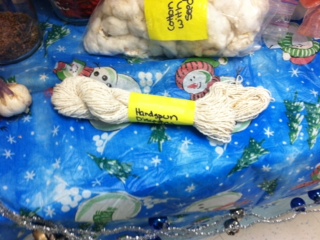
    Colonists first began to weave cotton in the early 1600s. Our 4th grade students learned how to card the cotton grown in the Discovery Garden. They created drop spindles and used them to make yarn. Mrs. Muto took some of the cotton home and used her loom to spin it into the yarn you see above.

1st Grade Peanut Harvest

Yum! 1st graders found a pleasant surprise when they dug up their peanut plants this fall. The 1st graders harvested the peanuts then let them dry for about 3 weeks. After the peanuts dried they used them to make peanut soup in class. The soup recipe was from a cookbook written by George Washinton Carver. Students also used a recipe from Carver to make peanut soap!
   Peanut plants have a long history. Remains of peanut hulls  7,600 years old are were discovered in Peru.


Tuesday, February 15, 2011

December/January: Waiting Out the Long Winter

As winter descends, we bid farewell to the 2010 Discovery Garden.  Most of our raised beds now lay fallow until Spring 2011, with the notable exception of the winter wheat crop that 4th graders planted in November.  Wheat has been a staple crop of many societies as far back as Ancient Egypt, where it was grown along the banks of the Nile River.  Our seeds germinated quickly after planting, and their bright green shoots quickly grew to a height of nearly four inches before the garden soil froze in early December.  These shoots now lay dormant until the spring thaw, when they will awaken, rapidly grow taller, and add shockingly vibrant green color to the early spring garden.  By June, they will lose their green color and morph into the "amber waves of grain" for which our "America, the Beautiful" is so famous.  Students will harvest and dry the wheat stalks, and then thresh and winnow the wheat from the chaff. 

"Who Will Help Me Bake the Bread?" asked the Little Red Hen.  This summer, Mrs. Occhuizzo took our 2010 Discovery Garden dried winter wheat kernels to the mill and had them ground into whole wheat flour.  In December and January, Kindergarten used the flour to bake fresh whole wheat bread!  Unlike in the tale of the Little Red Hen, the work of planting, growing, harvesting, threshing, milling, and baking our bread was a cooperative effort.  And of course, so was the process of eating it! YUM.

Sunflower Seed Bird Feeders for Terra Centre's Winter Birds 
To continue the cycle of life in the garden through the cold winter months, Mrs. Occhuizzo also worked with Kindergarten in December to make birdfeeders for the many winter birds that call the Discovery Garden their snowy, winter home.  Students used the dried seeds from our Mammoth Sunflowers that loomed over our summer garden in August.  We are happy to report that the Terra Centre cardinals, chickadees, and robin populations are quite well fed and very happy with their young Kindergarten friends!

Native American Miniature Popcorn--POP!  They planted it.  They grew it. They harvested it. They popped it!  2nd grade enjoyed popping the multi-colored kernels from our miniature Native American Popcorn this winter, which 4th grade harvested this fall in support of their studies on Native American cultures and Virginia History.  Students rubbed the dried ears together to remove the hardened kernels, and watched them pop in a real-life popcorn maker!  It was intersting for many of the students to see that this well-known, tasty treat can be made without a paper bag and a microwave! Who knew?

Virginia History Colonial Fair:  In December, 4th grade participated in the second annual Terra Centre Colonial Fair as part of their social studies unit on Virginia History.  For a 2nd year, Leigh Muto, a Terra Centre parent and active Discovery Gardener, attended the fair armed with her spinning wheel. She demonstrated to the students how to spin natural fibers (like the Monticello cotton we grow in the Discovery Garden) into cloth.  Students also performed the Virginia Reel for parents.

Natural Dyes from Marigolds:  Mrs. Occhuizzo also taught 4th graders how to dye natural cloth using the dried marigold flowers from the summer Discovery Garden.  These marigolds were grown from seed last February as part of the 6th grade gardening elective.  Students then transplanted the seedlings in a perimeter around each of the raised beds in May, where they stood as sentries all summer long to ward off invasive insects, which are detered by the scent of the marigolds--organic pest control! They were then picked and dried to be used in coloring cotton fabric, in the same manner used by the early settlers of Virginia. 

The International Journey North Tulip Project--When will spring arrive at Terra Centre?
1st grade's Journey North tulip bulbs are safely tucked under the frozen ground, and we are anxiously awaiting their emergence as a tool for measuring the arrival of spring.  Did you know that a tulip bulb must be exposed to at least two months of cold temperatures in order to emerge and bloom?  This is why some Journey North tulip gardens in Florida did not report emergence or bloom dates at all last year.  Once the winter snow melts, our 1st grade environmental scientists will need to keep a watchful eye on their tulip garden. When will spring arrive in Burke, VA?  Each 1st grader made a prediction of exactly what day they think their tulips will emerge.  We'll see if anyone guesses the correct date!  Check out the the interactive online Journey North map pattern to discovery patterns for the arrival of spring across North America: http://www.learner.org/jnorth/maps/tulips_spring2011.html.

November: Tucking in Discovery Garden for Winter

During the month of November, students, teachers, and parent volunteers were busy readying the Discovery Garden for its long winter's slumber.  As we pulled the final spent tomato plants from the raised beds, Junior Girl Scout Troop 173 volunteered their time and muscle to weather-treat the seven wooden raised bed frames and turn fresh new compost into our soil.  We are very thankful for their help.  Their efforts this fall have made the beds ready for planting again as soon as the ground thaws in March, and will ensure rich planting soil in the Discovery Garden next spring.

The International Journey North Tulip Project
For the third year in a row, our 1st graders are participating in the International Journey North Tulip Project.  Terra Centre 1st graders work with other schools across the Northern Hemisphere on a cooperative science experiment to track the emergence, growth, and bloom of the Red Emperor Tulip plant.  Journey North tulip bulbs are planted according to a specific scientific protocol in the fall at each of the participating schools.  Local emergence and bloom dates are recorded online as the seasons change from winter to spring in different regions of the Hemisphere.  These bright red tulips are early bloomers and are used as scientific tools for students to measure the arrival of spring in their hometown.  Emergence dates are plotted on an online map of North America, and students learn that spring arrives in different places at different times!  Our Terra Centre 1st graders have each made predictions for when "spring" will arrive in Burke.  We will see if any lucky student(s) picked the correct date of emergence for our Terra Centre Journey North tulips! 

Our careful observations about tulip emergence and bloom dates are also used by scientists to help track climate change patterns over time in the Northern Hemisphere.  How do differences in temperature, sunlight, geographic location, percipitation, and weather influence plant growth?  Will Spring 2011 arrive in Burke earlier or later than it did last year?

You can check out the Journey North Tulip map at:  http://www.learner.org/jnorth/maps/tulips_spring2011.html

Pansy Pattern Gardening
In November, our kindergarten classes worked cooperatively to design and plant their very own Pansy Pattern Garden.  Classes voted and chose an A-B-B-A math pattern of yellow and blue pansies.  They then divided the oval garden space into four separate areas (one per class), and each child had the experience of planting two pansies as part of the overall pattern.  The cold-tolerant pansies will survive the winter and continue to add beauty to the Discovery Garden throughout most of the spring.  Last year's Pansy Pattern Garden survived being buried under two feet of snow!


Earthworms Make America Great!
Every year, 1st graders at Terra Centre have the opportunity to study worms.  In November 2011, Mrs. Brinley's K-1 multi-age class took their learning to a new level by performing the off-beat musical, "Earthworms Make America Great".  Students sang 10 original songs about earthworms, including the blues-inspired "All My Worms Is Gone", the anatomically-oriented "Five Hearts", and the hoe down ditty, "My Compost Pile is Mighty High". The class also made Dirt Shirts for their costumes using soil from the Discovery Garden to naturally dye the shirts brown.


Tuesday, October 26, 2010

October: A Bountiful Harvest


Harvest Time!  As squirrels and critters are busy this October making preparations for their long winter, so to have our Terra Centre Tigers been busy harvesting their warm weather crops from last June and building food stores for winter.  This year's fall bounty includes heirloom tomatoes, bell peppers, green beans, miniature Indian popcorn, goose neck gourds, sugar baby pumpkins, mammoth sunflower heads, Virginia peanuts, basil, parsley, sage, oregano, mint, thyme, rosemary, and chives. 


Produce Donated to Food for Others. Much of our fall bounty has been consumed in the classrooms (Mrs. Beil's Green Tomato Cake was a hit for a 2nd year in a row!), but we are happy to report that Terra Centre families have made two trips already this year to Food for Others--a local food  bank that distributes our extra produce to needy families throughout our community (http://foodforothers.org/).

Peanut Harvest Fun! Also in October, our 1st graders, the K-1 class, and 4th graders had the opportunity to harvest Virginia peanuts.  Few garden experiences are more satisfying than tugging on a big, leafy green peanut plant to reveal a cluster of hidden peanuts pegged below the soil line.  Fourth graders coupled this experience with a lesson on the Origins of the Peanut and a trip to see peanut plants at Green Spring Gardens.  They can now readily identify peanut pegs and are familiar with the plants history, including its origins in Brazil or Peru (~3,500 years ago), its migration to Europe, Africa, and Asia with the Spanish explorers, and finaly its arrival in Virginia with the African slave trade. Later this year, 1st graders will draw connections between their experience harvesting peanut plants and George Washington Carver, the famous American scientist, botanist, educator, and inventor who is credited with developing 105 food recipes involving peanuts, as well as 100 useful products made from peanuts for the home and the farm.  Carver recognized the value of the peanut as a cash crop and recommended that it be planted as a rotational crop in the Southeast cotton-growing areas where the boll weevil insect was devastating regional agriculture.

El Jardin de Descubrimento.  After serving Discovery Garden salsa to her classes in honor of Spanish Heritage Month (thank you, 2nd grade chefs!), Senora Plante took her Spanish classes to the great outdoors.  Students spent time up in the Discovery Garden developing their vegetative Spanish vocabulary (pumpkin, tomato, flower, etc.) and singing fun garden songs. Senora Plante also recorded videos of her classes enjoying a hunt through the garden for her favorite and ever-blue classroom buddy, "Papa Pitufo" (a.k.a., Papa Smurf).

Corn Harvest  Did you know that corn and its many chemical derivatives are present in one form or another in most of the foods we consume?  Sodas, processed food additives and preservatives, most meats and dairy (feed lot cows, chickens, and pigs all eat...corn!).  Maize, or corn as we know it today, would not exist if it weren't for the people of central Mexico who cultivated and developed it nearly 7,000 years ago from a wild grass called teosinte. From this region, the crop migrated south to Peru and north to the Eastern Woodland Native American tribes of North America.  When Columbus and other European settlers landed in the New World, corn was a major component of the Native American diet. These explorers brought their new corn discovery back to Europe.  Did you know that corn is a human invention, a plant that does not exist naturally in the wild? It can only survive if planted and protected by humans. This month, our 4th graders helped harvest our Native American miniature popcorn crop, which our 2nd graders will "pop" later this year when they study Native American cultures.

The Discovery Garden Farmstand!  Those of you who attended Back to School night in mid-September may have noticed our new Discovery Garden Farmstand in the front hall of the school.  Mrs. Occhuizzo not only spent her summer dreaming up creative garden learning opportunities and recipes for our kids, but also constructing an entire Farmstand for them. Thank you Mrs. Occhuizzo!  Not only do the Terra Centre students, teachers, and parents love this wonderful addition to the main hallway, but the resident crickets in the building also love it! They can be heard chirping merrily from their cozy new perches in the decorative corn stalks.